




Aluminium weight formula
The weight of any aluminium part is its volume multiplied by its density. With dimensions in millimetres the volume comes out in cubic millimetres; divide by 1,000 to get cubic centimetres, then multiply by the density (g/cm³) to get the weight in grams.
| Cross-section | Volume formula (mm³) |
|---|---|
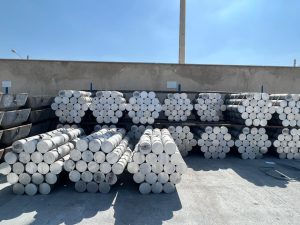
| Round bar, billet (cylinder) | π × D² ÷ 4 × L |
| Tube | π × (D² − (D − 2t)²) ÷ 4 × L |
| Sheet and flat bar | W × t × L |
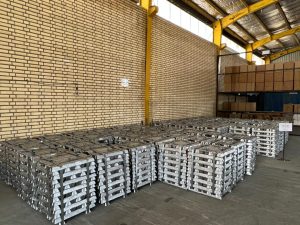
| Ingot, block | W × H × L |
Example: a billet 178 mm in diameter and 6 m long, with a density of 2.70:
π × 89² × 6000 ÷ 1000 × 2.70 ÷ 1000 ≈ 403 kg
Density of common aluminium alloys
| Alloy | Approx. density (g/cm³) |
|---|---|
| Pure aluminium (1xxx series) | 2.70 |
| 6063 (extrusions) | 2.69 |
| 6061 | 2.70 |
| 5083 | 2.66 |
| 2024 | 2.78 |
| 7075 | 2.81 |
| A356 | 2.68 |
| A380 | 2.71 |
| ADC12 | 2.74 |
| A413 | 2.66 |
| LM6 | 2.65 |
For a more precise result, enter your alloy's density in the calculator above. See the grades Almas produces in the aluminium alloy composition table, and contact us to buy aluminium ingot and billet.