
Skip to content
Almas AluminiumGOLPAYEGAN · IRAN

Glossary

Aluminium
glossary.

A glossary of aluminium and its alloys: a short definition of each term, from alloy series and anodizing to eutectic and T6, linked to a full article.

A

A356 A356.0 / A356.2
An aluminium–silicon–magnesium casting alloy with about 7% silicon, used after T6 heat treatment for car wheels and chassis parts. Read more
ADC12 JIS ADC12
The most widely used die-casting alloy under the Japanese standard, with 9.6–12% silicon and 1.5–3.5% copper; for automotive and appliance parts. Read more
Ageing
Holding an alloy after quenching at room temperature (natural ageing) or in an oven (artificial ageing) so fine precipitates form and strength rises. Read more
Alloying elements
Elements such as silicon, copper, magnesium, zinc, iron and manganese added to aluminium to change its strength, fluidity or machinability. Read more
Alloy series
The designation system for aluminium alloys based on the main alloying element: 1xxx (pure aluminium) to 8xxx for wrought alloys and 1xx.x to 8xx.x for cast alloys. Read more
Alumina Al₂O₃
Aluminium oxide: the intermediate product made from bauxite by the Bayer process and turned into aluminium metal by Hall–Héroult electrolysis. Read more
Aluminium Al
Element 13 of the periodic table; a light metal with a density of about 2.70 g/cm³ and a melting point of about 660 °C, and the world's most used non-ferrous metal. Read more
Aluminium billet
A long cylindrical ingot used as the starting material for extrusion and forging, mostly made from 6xxx-series alloys. Read more
Aluminium granules
Aluminium hemispheres of 80–99% purity used in steelmaking for deoxidation. Read more
Aluminium ingot
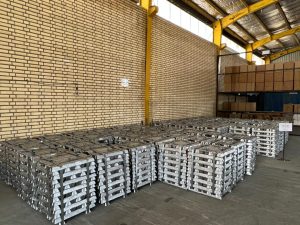
Solid blocks of pure or alloyed aluminium supplied for remelting by foundries and parts makers. Read more
Aluminium scrap
Scrap extrusions, sheet, cans, castings and turnings that become the raw material for secondary ingot after careful sorting. Read more
Aluminium vs steel
Aluminium weighs about a third as much as steel, resists corrosion better and conducts better; steel is stronger, stiffer and cheaper. Read more
Aluminium welding
Joining aluminium parts, mostly by TIG and MIG; the surface oxide layer and high thermal conductivity are the main challenges. Read more
Aluminium–silicon eutectic Al–Si
The composition with about 12.6% silicon that solidifies at an almost constant temperature of about 577 °C; the basis of LM6 and A413. Read more
Anodizing
An electrochemical process that builds a protective, decorative oxide layer on aluminium; the layer can be coloured and is then sealed. Read more

B

Bauxite
The main ore of aluminium, rich in aluminium hydroxides, and the starting point of the primary aluminium production chain. Read more
Bayer process
Dissolving bauxite in hot caustic soda and precipitating alumina; the first stage of primary aluminium production. Read more

C

Cast alloy
Alloys designed for casting parts, usually with high silicon for better fluidity, such as A356, ADC12 and LM6. In the American system they are coded xxx.x. Read more
Certificate of analysis CoA
The document a producer supplies with each shipment of ingot showing the chemical composition of that melt — the most important document when buying alloy ingot. Read more
Chemical analysis
The weight percentage of elements such as silicon, iron, copper, magnesium and zinc in an ingot or casting, which shows which standard grade the material matches. Read more
Cold shut
A defect that forms when two cool metal fronts meet in the mould and do not fully fuse, leaving a line or groove on the casting. Read more

D

Degassing
Removing dissolved hydrogen from the melt, usually by blowing inert gas through it with a rotor; the main way to prevent gas porosity. Read more
Density of aluminium
Pure aluminium has a density of about 2.70 g/cm³, roughly a third of steel; aluminium alloys range from about 2.65 to 2.81. Read more

E

Extruded profile
A product of extrusion with a constant cross-section, used in windows, doors, façades and structures; the most common alloy is 6063. Read more
Extrusion
Forcing a preheated billet through a die with a press to make profiles of constant cross-section, followed by quenching, stretching and ageing. Read more

F

Filler wire 4043 / 5356
4043 (aluminium–silicon) filler wire flows well, while 5356 (aluminium–magnesium) gives more strength; the choice depends on the part's alloy and use. Read more
Flux
Salts added to or spread on the melt to separate oxides and inclusions and protect the melt surface. Read more

G

Gas porosity
Small, round pores formed when hydrogen dissolved in the melt is released during solidification; one of the most common defects in aluminium casting. Read more
Gravity die casting
Pouring molten metal into a permanent metal mould under its own weight; it gives a better surface and mechanical properties than sand casting. Read more

H

Hall–Héroult process
Electrolysis of alumina dissolved in molten cryolite to produce aluminium metal; the most electricity-intensive stage of the chain. Read more
Heat treatment
The cycle of solution treatment, quenching and ageing used to strengthen heat-treatable alloys such as 6061, 7075 and A356. Read more
High-pressure die casting HPDC
Injecting molten metal at high speed and pressure into a steel die to make thin-walled parts in large volumes, usually with alloys such as ADC12, A380 and A413. Read more
Hot tearing
A crack that forms in the final stages of solidification because the casting's shrinkage is restrained by the mould. Read more

I

Inclusion
Non-metallic particles such as oxides and oxide films trapped in the melt that reduce the strength and surface quality of a casting; controlled by fluxing and filtration. Read more
Ingot price factors
The price of alloy ingot depends on the LME price, exchange rates, the cost of alloying elements, energy costs and the alloy grade. Read more

L

LME aluminium price
The price of aluminium on the London Metal Exchange (LME) in US dollars per tonne; the benchmark for ingot prices worldwide. Read more
Low-pressure die casting LPDC
Filling a metal mould from below using low gas pressure on the melt surface; the usual way of making aluminium wheels from A356. Read more

M

Melting point of aluminium
Pure aluminium melts at about 660 °C; alloys melt over a range between the solidus and liquidus temperatures. Read more

P

Primary aluminium
Aluminium produced directly from alumina by Hall–Héroult electrolysis; high purity but very energy-intensive. Read more

Q

Quenching
Rapidly cooling a part (usually in water) after solution treatment so that the alloying elements stay in solid solution, ready for ageing. Read more

R

Recycling
Remelting aluminium scrap; it uses about 95% less energy than production from bauxite, and aluminium can be recycled again and again without losing its properties. Read more

S

Sand casting
Pouring molten metal into a single-use sand mould; suited to large parts and small volumes with low tooling costs. Read more
Secondary aluminium
Ingot made by melting sorted scrap and adjusting its chemistry; most foundry alloy ingot is of this type. Read more
Shrinkage porosity
Irregular cavities caused by a lack of feed metal during solidification shrinkage, usually in thick sections of a casting. Read more
Silicon Si
The most important alloying element in aluminium casting alloys; it increases the fluidity of the melt and reduces solidification shrinkage. Read more
Silumin
The common name for aluminium–silicon casting alloys close to the eutectic composition (about 11–13% silicon); equivalents include LM6, A413 and AlSi12. Read more
Steel deoxidation
Adding aluminium (usually as granules or hemispheres) to molten steel so that it combines with dissolved oxygen and produces killed steel. Read more

T

T6 Temper T6
Solution treatment, quenching and artificial ageing; the most common temper for reaching maximum strength in heat-treatable alloys. Read more
Temper
A code showing the metallurgical condition of an alloy after processing, such as F (as cast), O (annealed), H (strain-hardened) and T4, T5 and T6 (heat-treated). Read more

W

Weight calculation
The weight of any part is its volume × density; calculate the weight of aluminium bar, tube, sheet and ingot with our online tool. Read more
Wrought alloy
Alloys shaped by rolling, extrusion or forging and identified by four-digit codes from 1xxx to 8xxx, such as 6063, 6061 and 7075. Read more

0–9

6061 AA 6061
A wrought aluminium–magnesium–silicon alloy with medium to high strength, used for structures and machined parts. Read more
6063 AA 6063
The main alloy for architectural profiles, with excellent extrudability, a fine surface finish and good response to anodizing. Read more
7075 AA 7075
An aluminium–zinc–magnesium–copper alloy and one of the strongest common aluminium alloys in the T6 temper; used in aerospace and mould making. Read more

Where to start

If you are new to aluminium, start with what is aluminium?, then read about aluminium alloy series and aluminium ingot. To choose a grade, see the alloy composition table; before you buy, read the aluminium ingot buying guide.

All our technical writing is in the aluminium articles section.