


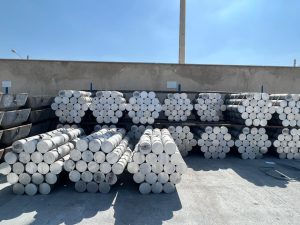
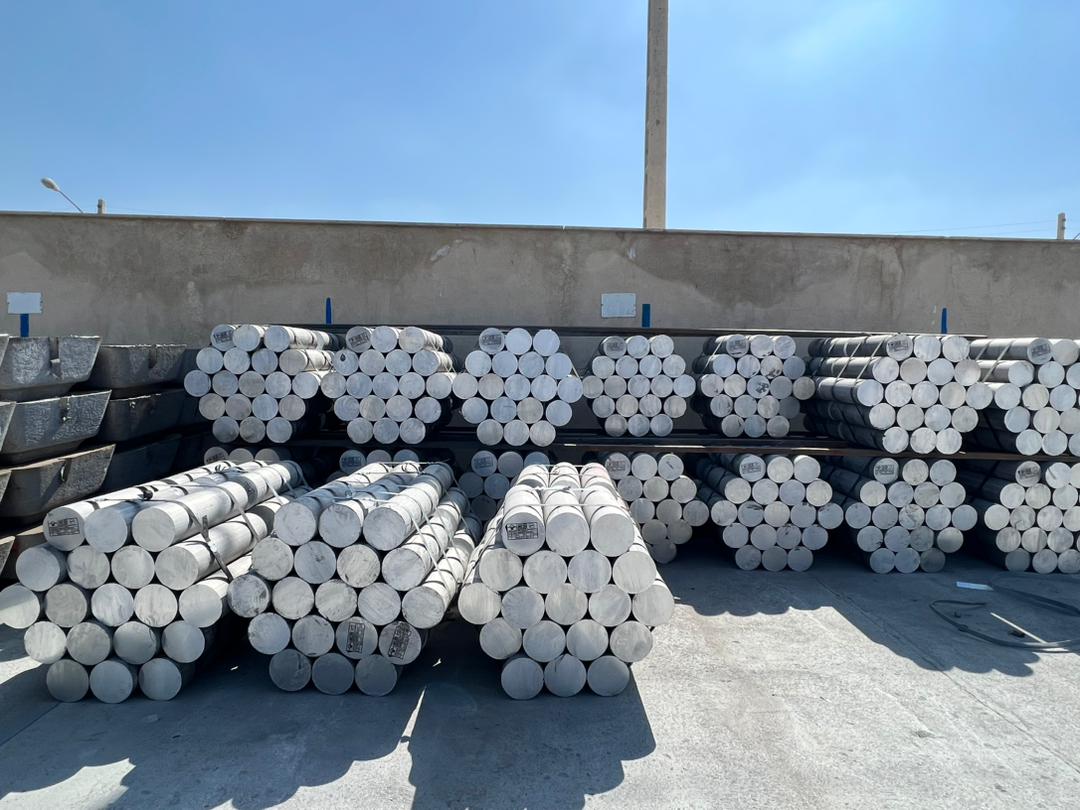
An aluminium billet is a long cylindrical ingot used mainly as the starting material for forming processes such as extrusion (making profiles) and forging. Its cylindrical shape means it can go straight into the press once it has been cut to length and preheated.
Billet versus ingot
Ingot is usually made to be remelted and cast into parts, whereas billet is designed to be formed in the solid state. That is why, for billet, the internal structure (grain size and uniformity) and the surface quality matter as much as the chemical composition.
How is billet made?
Billets are usually produced by direct-chill (DC) casting as long logs. They are then homogenized — a heat treatment that evens out the distribution of the alloying elements and improves formability — and cut to the lengths required.
Common billet alloys
The 6xxx-series alloys (aluminium–magnesium–silicon) such as 6063, 6061 and 6082 are the most widely used extrusion billet alloys. 6063 is chosen for architectural and building profiles with a clean surface, while 6061 and 6082 are used for structural applications that need more strength.
What makes a good billet
- Accurate, uniform chemistry along the full length of the billet
- A fine-grained structure free of cracks and porosity
- Low hydrogen and inclusion (non-metallic impurity) content
- A smooth surface and accurate dimensions (diameter and straightness)
See the specifications of Almas aluminium alloy billet, or talk to our sales team for advice on the right alloy.