


Fluidity is the ability of a melt to fill a mould before it solidifies, and in thin, complex parts it decides whether a casting comes out complete or short. Research from the Iran University of Science and Technology and Qazvin International University shows that iron, the most common impurity in aluminium–silicon alloys, noticeably reduces the fluidity of 413 alloy, and that the way the melt is held in the furnace can make this worse or better.
413 alloy and the iron problem
413 is a eutectic aluminium alloy with about 12% silicon, used for thin-walled and die-cast parts because of its excellent castability. Iron is almost always present: it enters the melt from scrap, melting tools and even the crucible. The trouble is that iron barely dissolves in aluminium and separates as intermetallic compounds. The best known is β-Al5FeSi, which appears as long plates or needles in the microstructure and harms both mechanical properties and melt flow. See also our article on aluminium scrap.
What the study examined
Using a vacuum fluidity test, the researchers studied 413 alloy with iron contents from about 0.35% to 1.8% in two states: without manganese and with manganese added. Manganese is the most common way to neutralise iron, because it turns the needle-like β phase into the more compact, "Chinese script" α-Al15(Fe,Mn)3Si2 phase. They also measured the effect of holding the melt at the pouring temperature and of superheating it above that temperature.
Main findings
- More iron means lower fluidity, both with and without manganese. The needle-like β-Al5FeSi phase is the most harmful to fluidity.
- Manganese helps: at the same iron content or the same segregation factor, the manganese-modified melts flowed better than the unmodified ones.
- Holding a manganese-modified melt is risky: when it was held at the pouring temperature, the α particles clumped together into sludge and fluidity fell sharply. The unmodified alloy was less sensitive to holding time.
- Enough superheat is the remedy: superheat and a holding time matched to the alloy's segregation factor dissolve the iron-bearing compounds and raise the fluidity of the modified alloy at the same pouring temperature.
What is the segregation (sludge) factor?
A simple formula predicts the risk of sludge: SF = %Fe + 2×%Mn + 3×%Cr. The higher this number, the higher the temperature below which sludge forms, so holding furnaces must be kept above it, especially in die casting where holding temperatures are usually low. This is also why manganese cannot be added without limit: it neutralises iron, but too much of it raises the SF.
What it means for foundries and ingot buyers
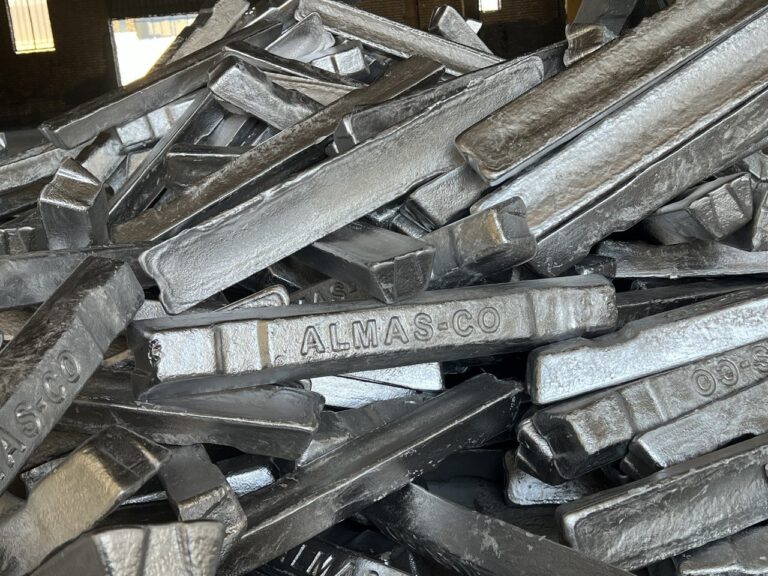
The practical lesson is simple: casting quality depends not only on the alloy name but also on the exact iron content, the Mn/Fe ratio and temperature control in the furnace. An ingot with controlled iron and a suitable Mn/Fe ratio forms less sludge in the furnace and fills thin-walled parts better. At Almas Aluminium, the chemical composition of every melt is checked in the laboratory so that the ingot delivered is within the standard range of the grade ordered. See also our guides to high-pressure die casting and buying aluminium ingot.
Frequently asked questions
Is adding manganese always beneficial?
No. Manganese converts the β phase into α, but too much of it raises the segregation factor and causes sludge at low furnace temperatures. A manganese-to-iron ratio of about one half is a common guideline, and the holding temperature must match the SF.
Why is furnace sludge harmful?
Sludge particles are heavy and hard. They settle on the furnace floor, change the melt composition and reduce fluidity, and if they end up in a casting they make machining harder and weaken it.
How can I tell if an alloy is at risk of sludge?
Measure iron, manganese and chromium by spectrometry, calculate the SF and keep the holding temperature above the corresponding sludge formation temperature.
Source
E. Taghaddos, M.M. Hejazi, R. Taghiabadi, S.G. Shabestari, "Effect of iron-intermetallics on the fluidity of 413 aluminum alloy", Journal of Alloys and Compounds, 468 (2009) 539–545. DOI: 10.1016/j.jallcom.2008.01.079. Read the original paper
This article is the Almas Aluminium editorial team's summary of a published research paper. For the full experiments, tables and figures, please refer to the original paper.