


AS7U3G is an aluminium–silicon–copper casting alloy used in automotive and transport parts. Researchers at Isfahan University of Technology studied how the type of mould and the cooling rate change its microstructure and how much that affects strength, and to predict it they determined the constants of the modified Hall–Petch equation for this alloy.
What is AS7U3G?
AS7U3G is the French designation of an alloy with about 7% silicon (S7), about 3% copper (U3) and some magnesium (G). It is hypoeutectic: its silicon is below the eutectic composition (about 12.6%), so its microstructure consists of aluminium dendrites with eutectic silicon between them. Copper and magnesium make it hardenable by heat treatment.
Two microstructural variables that set strength
- Secondary dendrite arm spacing (SDAS): the faster the melt solidifies, the finer the dendrites and the smaller the spacing between their arms.
- Thickness of the eutectic silicon plates: coarse silicon plates are brittle and start cracks more easily.
The modified Hall–Petch equation expresses the effect of these two variables on yield and tensile strength. Both depend in turn on composition, cooling rate and melt treatment (such as modification and grain refinement).
How the study was done
AS7U3G was poured at 750 °C into three moulds: a sand mould, a preheated steel mould and a water-cooled steel mould. The cooling rate was measured by thermal analysis, the microstructure was quantified by metallography and the samples were tensile tested.
Findings
- The cooling rate in the water-cooled metal mould was 15.7 times that of the sand mould.
- As a result, the average secondary dendrite arm spacing fell from 54 µm to 17 µm.
- Reducing SDAS from 45 to 17 µm raised yield strength by about 16.5% and tensile strength by about 6.5%.
- From the metallography and tensile data, the modified Hall–Petch constants for AS7U3G were determined, so strength can be estimated from cooling rate and microstructure, and conversely, solidification conditions can be designed to reach a target strength.
The Hall–Petch equation in plain terms
The Hall–Petch equation was originally stated for single-phase metals and says that finer grains give higher yield strength. In cast aluminium–silicon alloys, dendrite arm spacing and silicon plate thickness take the place of grain size. The modified equation uses a few empirical constants to give the contribution of each of these two variables.
Practical importance
These results explain why one alloy gives different properties in sand casting, gravity die casting and high-pressure die casting. For designers, the equations are a tool for predicting the properties of different sections of a part with different wall thicknesses. For foundries, the message is that mould choice, mould temperature and cooling matter as much as chemistry. Compare the methods in gravity vs sand casting.
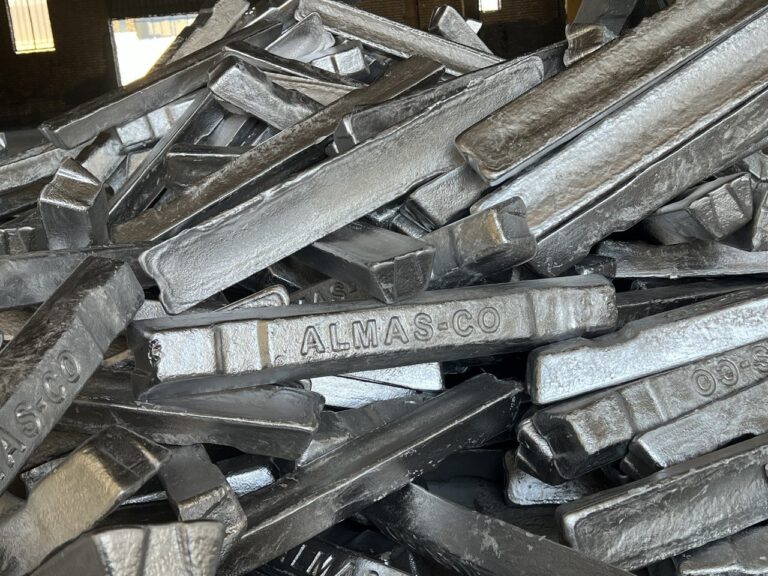
The foundation of all this is ingot of the right composition. Almas Aluminium produces Al-Si-Cu alloy ingot with composition control on every melt; see the grades.
Frequently asked questions
What is the equivalent of AS7U3G in other standards?
In composition AS7U3G is close to the Al-Si7-Cu3-Mg alloys of the European EN 1706 standard (such as EN AC-46300). When ordering, always specify the exact composition required.
Why did yield strength rise more than tensile strength?
A finer microstructure mainly affects the onset of plastic deformation (yield); ultimate tensile strength also depends on other factors such as defects and brittle particles.
Source
M. Lashani Zand, B. Niroumand, A. Maleki, "Determination of the Modified Hall-Petch Equation Constants and the Relationship Between the Microstructure and Mechanical Properties of AS7U3G Alloy" (in Persian), Journal of Advanced Materials in Engineering (Isfahan University of Technology), 37(4), winter 2019. DOI: 10.29252/jame.37.4.91. Read the original paper
This article is the Almas Aluminium editorial team's summary of a published research paper. For the full experiments, tables and figures, please refer to the original paper.