


319 aluminium alloy is one of the most widely used casting alloys for cylinder heads, engine blocks and automotive parts. Researchers at the University of Tehran's Faculty of Engineering studied which compounds iron forms in this alloy, how manganese controls them and whether heat treatment can dissolve iron-bearing particles, including sludge.
319 alloy and iron
319 is an alloy with about 6% silicon and 3.5% copper. Iron is a common impurity, especially when it is made from scrap. It mostly appears as needle-like β-Al5FeSi, which lowers strength and especially ductility. Several methods reduce this effect: adding elements such as manganese, chromium, beryllium or strontium, faster cooling, and superheating the melt before pouring.
How the study was done
319 alloy was prepared with three iron levels (0.6, 1 and 1.4%) and various manganese levels (from about 0.27% to 0.9%). The samples were then solution treated at 515 °C for 4 to 26 hours and quenched in water at 60 °C. The microstructure was examined by optical and electron microscopy and elemental mapping.
Findings
- Manganese changes the iron phase: with manganese, the iron-bearing phase formed as α with "Chinese script" and polyhedral shapes. The polyhedral form is what builds up into furnace sludge.
- Manganese must match iron: if the manganese level is chosen in proportion to the iron, it neutralises iron and prevents needle-like β.
- More iron and manganese, more phase: raising iron and manganese together increased the total area fraction of iron-bearing phases.
- Solution treatment dissolves and fragments particles: long solution treatment at 515 °C dissolved and broke up the Chinese-script α phase and partly dissolved the polyhedral (sludge) phase; some polyhedral particles even changed to Chinese script.
- Dissolution mechanism: α dissolves as silicon atoms leave the particle and diffuse into the matrix. The limited solubility of iron in solid aluminium explains why particles change shape instead of disappearing completely.
Sludge in 319 alloy
In melts with high iron and manganese held at low temperature, polyhedral α particles stick together and settle on the furnace floor. This sludge changes the melt composition and, if it gets into a casting, makes machining harder. Calculating the sludge factor (Fe + 2Mn + 3Cr) and holding the melt above the sludge formation temperature prevents it.
Practical conclusion
The study shows two complementary tools: chemical control (the Mn/Fe ratio) at the melting stage and thermal control (solution treatment) after casting. The first is cheaper and more reliable; long solution treatment costs energy and does not remove every particle. The best approach is to control iron in the ingot from the start. Read more in our ingot buying guide and common casting defects.
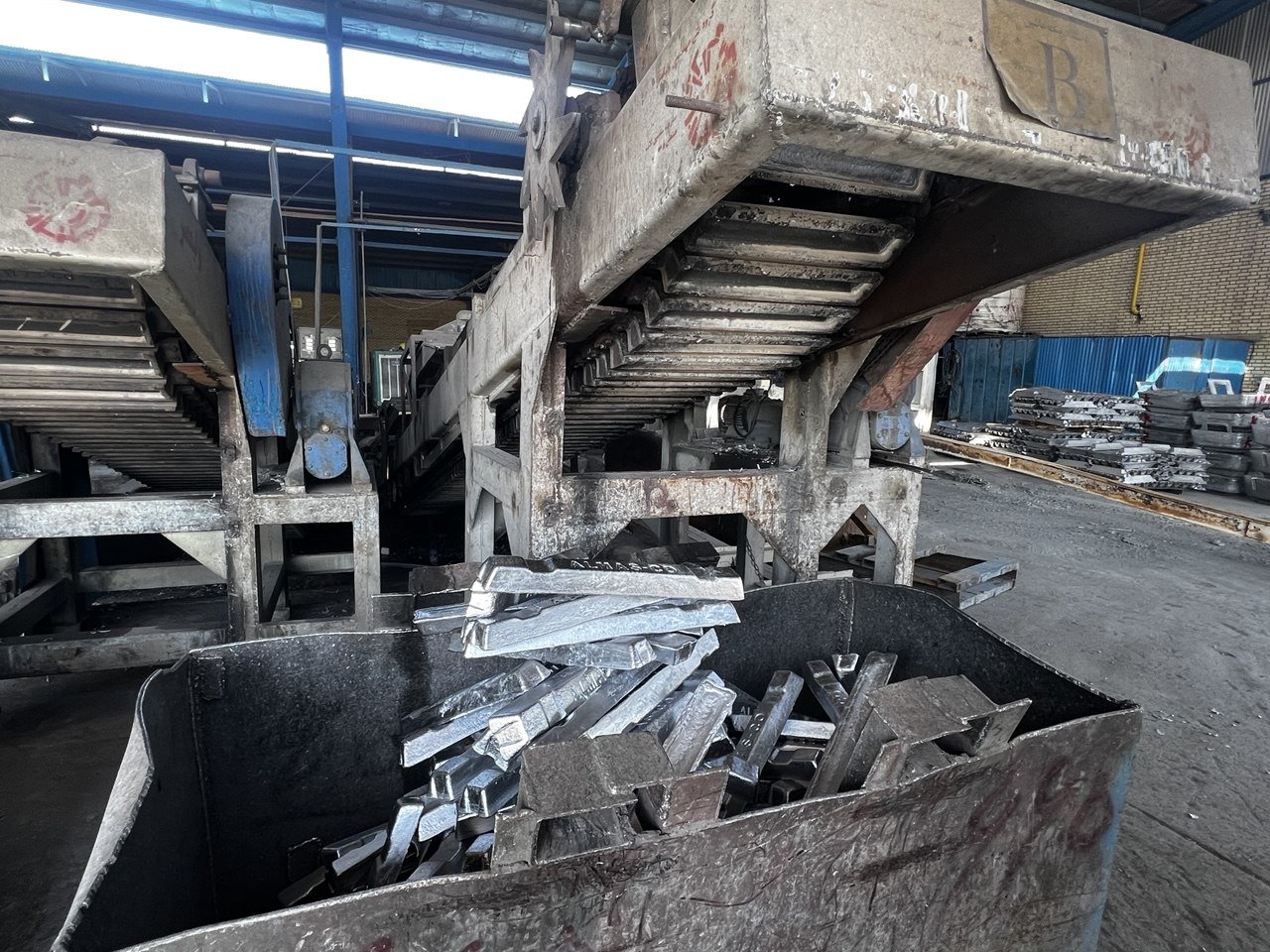
Almas Aluminium produces alloy ingot with composition control in the plant laboratory. For Al-Si-Cu grades, contact our sales team.
Frequently asked questions
What is the difference between the α and β phases?
β-Al5FeSi is plate- or needle-shaped and very harmful. α-Al15(Fe,Mn)3Si2, which forms when manganese is present, has a more compact Chinese-script or polyhedral shape and is less harmful, provided it does not coarsen into sludge.
Can solution treatment replace iron control?
No. Solution treatment can dissolve or refine some particles, but it is slow and costly. Controlling iron and manganese in the ingot and melt is the main route.
Source
H. Zahedi, M. Emami, "Control of the microstructure of iron-bearing intermetallics in 319 aluminium alloy by manganese addition and solution heat treatment" (in Persian), Journal of the Faculty of Engineering, University of Tehran, 39(6), March 2006, 801–812.
This article is the Almas Aluminium editorial team's summary of a published research paper. For the full experiments, tables and figures, please refer to the original paper.