
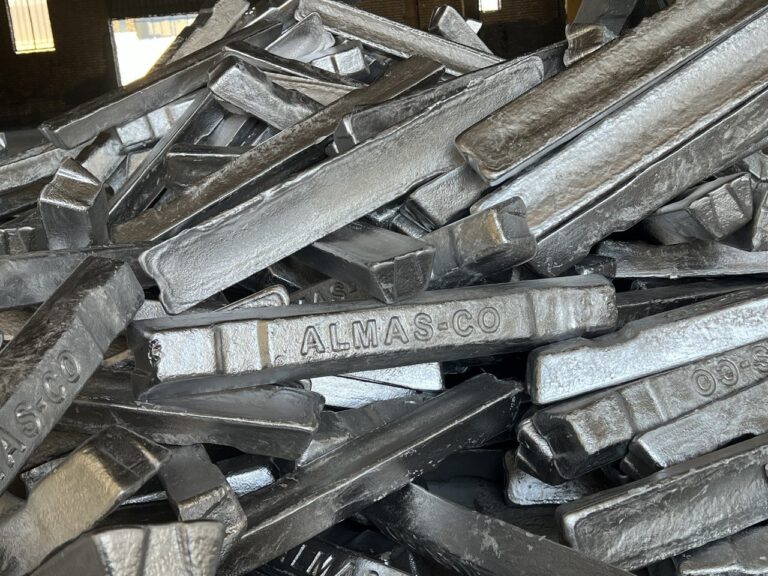
Many aluminium billet producers in Iran use scrap as their raw material. A study by the University of Sistan and Baluchestan examined 6063 billets from a scrap-based producer in Zahedan and compared them with billet from Arak Aluminium (IRALCO). The results show clearly the main quality challenges of billet made from scrap.
6063 billet and its standard
6063 is the most widely used extrusion alloy for building and industrial profiles. Its standard calls for 0.45–0.9% magnesium and 0.2–0.6% silicon, iron below 0.35% and copper and chromium each below 0.1%. These limits are not arbitrary: magnesium and silicon together form the strengthening Mg2Si phase, and high iron forms brittle compounds. See our aluminium billet guide and the 6061 vs 6063 comparison.
Raw materials and method
The producer's raw materials were mixed scrap such as cans, profiles, rivets and cooling fins. The researchers measured billet composition by spectrometry, identified the phases by X-ray diffraction and scanning electron microscopy with elemental analysis, and took tensile samples from the centre and the surface of the billet.
Findings
- Off-standard composition: silicon 0.64–0.65% (above the limit), magnesium 0.22–0.26% (well below the 0.45% minimum) and iron 1–1.12%, almost three times the limit. Copper was also above the standard.
- Brittle iron aluminide: about 4% of the microstructure by volume consisted of lamellar iron-rich particles, identified as an iron aluminide intermetallic.
- Solidification cavities: a large shrinkage cavity was found in the centre of the billet.
- Mechanical properties: tensile strength was 93–103 MPa, but ductility was about 50% lower than a comparable IRALCO sample. Strength and ductility at the billet centre were much lower than at the surface, while the IRALCO billet behaved almost the same at centre and surface.
Causes of the poor quality
The researchers identified two main causes: cavities at the billet centre, which reduce the effective cross-section and make fracture easier, and high iron and copper, which form the brittle iron aluminide and reduce ductility. The low magnesium also means too little strengthening Mg2Si forms, so the billet will not reach the expected strength after extrusion and ageing.
Lessons for producing and buying billet
- Sort the scrap: high-iron scrap (such as parts with steel screws and fasteners) must be separated; iron is practically impossible to remove from molten aluminium.
- Correct the composition: low magnesium must be brought into range with pure magnesium.
- Control solidification: proper casting speed and cooling in semi-continuous casting prevent centre cavities.
- Analyse every melt: buyers should ask for a certificate of analysis for each shipment and check iron and magnesium.
At Almas Aluminium, the composition of every melt is checked in the plant laboratory so that the billet and ingot delivered match the grade ordered. See our products.
Frequently asked questions
Can billet made from scrap meet the standard?
Yes, provided the scrap is carefully sorted, the composition is corrected with pure elements and the casting process is controlled. The problem in this study was the lack of these controls, not the use of scrap itself.
How does high iron in 6063 billet affect profiles?
High iron reduces ductility, lowers the surface quality of profiles and weakens the response to anodizing, which is why the standard limits it to 0.35%.
Source
R. Shahriyari, M. Sharifitabar, M. Shafiee Afarani, "Investigation of microstructure and mechanical properties of aluminum alloy parts manufactured by Balouch Aluminum Co.", Journal of Metallurgical and Materials Engineering (Ferdowsi University of Mashhad), 34(2), 2023, 51–66. DOI: 10.22067/jmme.2023.81263.1105. Read the original paper
This article is the Almas Aluminium editorial team's summary of a published research paper. For the full experiments, tables and figures, please refer to the original paper.